
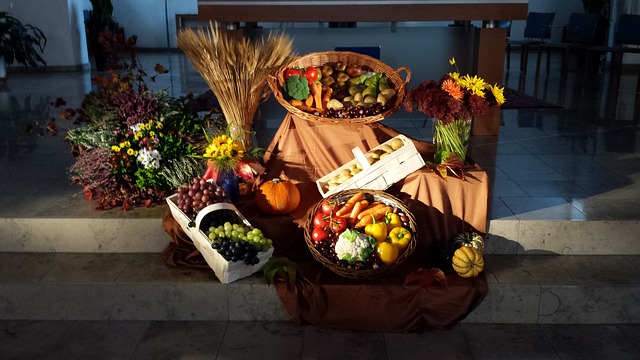
For all that has been given to us by god, the gifts of nature, the rivers, the rain, waterfalls, food to eat, water to drink, the clouds, our relationships, everything we require to express our gratitude for all this. So lets come together to thank god for all what has made our life possible.
In Canada, Thanksgiving is celebrated on the second Monday in October. The origin and history of Thanksgiving Day in Canada is different from the American Thanksgiving. Whereas the American tradition talks about remembering Pilgrims and settling in the New World, Canadians give thanks for a successful harvest. The geographical location of Canada is further north as compared to the United States therefore the harvest season falls earlier in Canada.
When is Canadian Thanksgiving 2022 Date:
Thanksgiving 2022 in Canada will be celebrated on second Monday in October – 10th October 2022.
History and Origin of Canadian Thanksgiving
There are three traditions behind Canadian Thanksgiving Day:
First, The farmers in Europe held celebrations at the time of harvesting to give thanks for their good fortune of a bountiful harvest and abundance of food. The farmers would fill a goat’s curved horn with fruits and grains. This curved horn was known as a cornucopia or the horn of plenty. It is believed that when the European farmers came to Canada they brought this tradition of Thanksgiving with them.
Second, The history of Thanksgiving in Canada is related to Martin Frobisher, who was an English navigator. He made a lot of efforts to find a northern passage to the Orient. Though he did not succeed in his efforts but he was able to establish a settlement in Northern America. In the year 1578, he held a formal ceremony, in what is now known as Newfoundland, to give thanks for surviving the long journey. This is considered the first Canadian Thanksgiving. Martin Frobisher was later knighted and an inlet of the Atlantic Ocean in northern Canada was named as ‘Frobisher Bay‘ after him. When other settlers arrived here they continued this ceremony of giving thanks.
Third, The third influence occurred in 1621 in what is now the United States. Here the pilgrims, who were the English colonists, celebrated their first harvest in the New World at Plymouth Massachusetts. By the 1750s this celebration of harvest was brought to Nova Scotia by American settlers from the south.
In the 1600s, another navigator Samuel de Champlain crossed the ocean and arrived to Canada. Other French Settlers also came with him and their group held huge feasts of thanks for the harvests. On this event they shared their food with the Native American neighbors and thus involved them in their celebrations. Then they formed ‘The Order of Good Cheer’which marked the harvests and other events as well.
After the Seven Year’s War ended in 1763, the citizens of Halifax held a special day of Thanksgiving.
During the American Revolution the Americans who remained loyal to England moved to Canada. They brought with themselves the customs and practices of the American Thanksgiving to Canada.
In 1879, the Parliament declared 6th day of November as the day of Thanksgiving and also declared it a national holiday. Over the years different dates were used for celebrating the Thanksgiving Day in Canada but the most popular date was the 3rd Monday of October.
After World War I, both Armistice Day and Thanksgiving Day were celebrated on a common day that was Monday of the week in which fell the 11th day of November. Ten years later, in 1931, both Armistice Day and Thanksgiving Day became separate holidays and Armistice Day was renamed as the ‘Remembrance Day’.
Finally, on January 31st, 1957, the Parliament issued a proclamation to fix permanently the 2nd Monday in October as the Thanksgiving Day. The Proclamation goes as…
“A Day of General Thanksgiving to Almighty God for the bountiful harvest with which Canada has been blessed … to be observed on the 2nd Monday in October…”
So lets celebrate Canadian Thanksgiving 2022.